
France’s Last Guillotine Execution

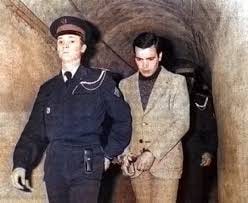
On September 9, 1977, at 4:40am convicted murderer, Hamida Djandoubi was led to the guillotine. Monique Mabelly, a judge assigned to witness his execution, took notes of his last living moments. “One of the executioner’s aides nimbly pulls a pair of scissors from the pocket of his jacket and begins cutting the collar of the prisoner’s blue shirt.” With no obstruction for the blade the execution moves forth. Mabelly wrote, “The body is practically thrown flat on its stomach. I turn away…I hear a deafening noise. I turn back – blood, a lot of blood, very red blood. In an instant, a life has been cut…One of the guards picks up a hose…”
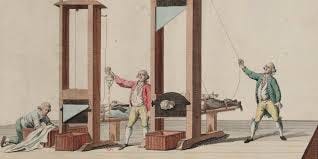
The guillotine was first conceived by its namesake, Dr. Joseph Guillotine on October 10, 1789, while France was in the throes of its revolution. (Actually, a Civil War). Prior executions were performed with a rope or sword, but Dr. Guillotine believed his method to be quick and less painful. In 1791, the Assembly voted for decapitation as the only means of execution. The initial device was designed by Dr. Antoine Louis and built by Tobias Schmidt, a German harpsichord manufacturer. On April 22, 1792, a habitual thief named Nicholas Jacques Pelletier was the first to lose his head to France’s new killing machine, which was then called the Louison or Louisette for its designer, who ironically would be decapitated by his own device on May 20, 1792. Over time, the Louison came to be known as the Guillotine, named for the man who championed it as a humane tool. Twenty-two years after Dr. Guillotine’s death, his descendants petitioned the French government for a name change, were denied, but allowed to change their surname.

During France’s Reign of Terror, it is estimated by historians that fifty people were guillotined a day.
In 1939, killer Eugene Weidmann was the last person to be publicly beheaded. Witnesses were rowdy and hostile, with individuals running up to the machine to dip their handkerchiefs in the wet blood for a grisly souvenir. Albert Lebrunm, the President of France, was so horrified by the crowd’s behavior that he forbade future public executions.
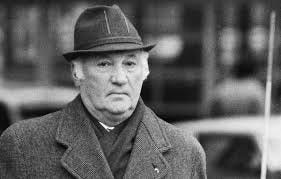
Hamida Djandoubi was France’s final guillotine execution. Overseeing the final drop of the blade was Marcel Chevalier, the chief executioner of France and his aides, one of which was his son, 24-year-old Eric, who was on hand to learn the trade and someday replace his father as it was customary in France for the Chief Executioner’s job to be handed down through his family. Marcel had inherited his post from his wife’s uncle who had no sons of his own. For his work, Marcel received a monthly payment of 3,650 francs and another 6,000 francs for each execution. When he was not moonlighting as an executioner, he dabbled in his full-time job as a printer. From 1958 to 1977, Chevalier either assisted or oversaw forty executions. Of his final job, a witness reported that Djandoubi remained conscious for up to thirty seconds following the execution.
This was not a rare occurrence. Doctors contend that the head, perhaps knocked unconscious by the falling blade’s blow and subsequent blood loss maintains life for up to 10 to 13 seconds after it is severed from the body, a peculiar fact attributed to the head subsisting on the remaining blood and glucose levels in the brain.
The most detailed and debated study of this phenomenon was recorded by a Dr. Beaurieux on June 28th, 1905, while attending the execution of murderer Henri Languille. He wrote, “…I was able to note immediately after the decapitation: the eyelids and lips of the guillotined man worked in irregularly rhythmic contractions for about five to six seconds. This phenomenon has been remarked by all there…I waited for several seconds. The spasmodic movements ceased. The face relaxed, the lids half closed on the eyeballs leaving only the white of conjunctiva visible…It was then that I called in a strong, sharp voice: ‘Languille!’ I saw the eyelids slowly lift up, without any spasmodic contractions…Next Languille’s eyes very definitely fixed themselves on mine and the pupils focused themselves…After several seconds, the eyelids closed again, slowly and evenly and the head took on the same appearance as it had had before I called out. It was at that point that I called out again and, once more, without any spasm, slowly, the eyelids lifted and undeniably living eyes focused themselves on mine with perhaps even more penetration than the first time. Then there was a further closing of the eyelids, but now less complete. I attempted the effect of a third call; there was no further movement, and the eyes took on the glazed look which they have in the dead…The whole thing last twenty-five to thirty seconds.”
In 1981, France outlawed execution, relieving both Marcel and Eric of their posts.
Though exact figures are not known, it believed that 15,000 to 40,000 people died by the guillotine in the almost 200-year history of the machine.